
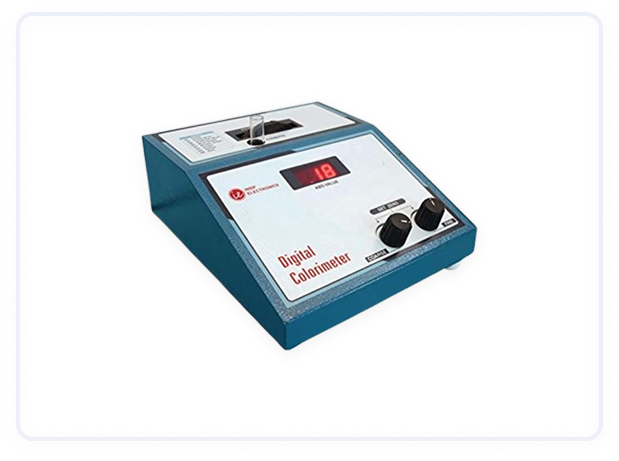
Colorimeter
A colorimeter is a scientific instrument used to measure the color of a substance or solution. It evaluates the absorbance of specific wavelengths of light by a sample and is widely used in laboratory settings, particularly in fields like chemistry, biology, and environmental science, for analyzing the concentration of substances based on color changes.
Key Features of a Colorimeter
Light Source : Colorimeters use a light source (usually a LED or tungsten bulb) that emits light of specific wavelengths. This light is directed through the sample to measure its color properties.
Filters : A color filter or monochromatic filter is used to isolate light of specific wavelengths to pass through the sample. Different filters are used depending on the color of the sample being measured.
Photodetector : After the light passes through the sample, the remaining light (either absorbed or transmitted) is captured by a photodetector or light sensor, which measures the intensity of the transmitted light.
Display/Readout : The intensity of the transmitted light is then converted into a color value, and the result is displayed as absorbance, transmittance, or a specific color value (like RGB or CMYK, depending on the application).
Sample Holder : Colorimeters typically have a cuvette holder or sample chamber where the liquid sample is placed for testing. The sample holder ensures proper alignment for light transmission.
Calibration : Most colorimeters require calibration with a reference standard (like a known concentration of a substance or a color solution) to ensure accurate measurements.
Types of Colorimeters
Visible Light Colorimeter : This is the most common type, measuring the absorption or transmission of light in the visible spectrum (approximately 400–700 nm). It is used for analyzing colored solutions like chemical reagents or biological samples.
RGB Colorimeter : These colorimeters are used for evaluating the color of light in terms of Red, Green, and Blue values, typically used in digital imaging, graphic design, and monitor calibration.
Turbidimeter : A specific type of colorimeter designed to measure the turbidity (cloudiness) of a solution, based on the scattering of light.
Dual-Wavelength Colorimeter : Uses two different wavelengths to measure absorbance, improving accuracy, especially when measuring samples with overlapping absorbance peaks.
Handheld or Portable Colorimeter : Compact and easy to use in field settings or for routine testing, such as in water quality monitoring or food safety.
Types of Colorimeters
Visible Light Colorimeter : This is the most common type, measuring the absorption or transmission of light in the visible spectrum (approximately 400–700 nm). It is used for analyzing colored solutions like chemical reagents or biological samples.
RGB Colorimeter : These colorimeters are used for evaluating the color of light in terms of Red, Green, and Blue values, typically used in digital imaging, graphic design, and monitor calibration.
Turbidimeter : A specific type of colorimeter designed to measure the turbidity (cloudiness) of a solution, based on the scattering of light.
Dual-Wavelength Colorimeter : Uses two different wavelengths to measure absorbance, improving accuracy, especially when measuring samples with overlapping absorbance peaks.
Handheld or Portable Colorimeter : Compact and easy to use in field settings or for routine testing, such as in water quality monitoring or food safety.
Various industries
Request More Information
Contact Us to learn more about our offerings or Request a Quote to get started today!
Contact Us

