
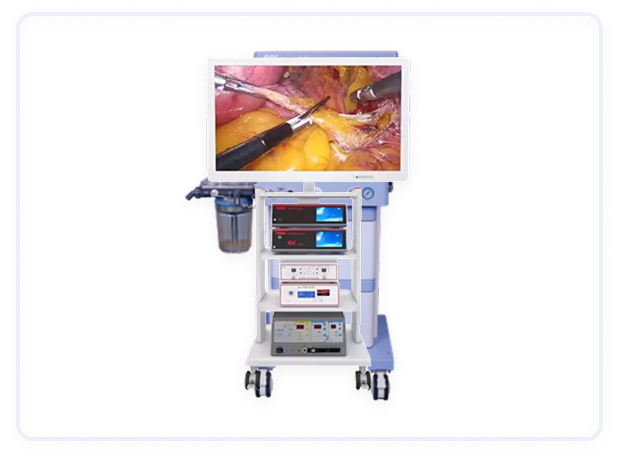
Laparoscopy
Laparoscopy is a minimally invasive surgical technique used to examine and treat conditions inside the abdomen or pelvis. Also referred to as keyhole surgery or minimally invasive surgery, laparoscopy involves making small incisions (usually between 0.5 to 1 cm) through which a camera (laparoscope) and surgical instruments are inserted to perform procedures. This technique is commonly used in a variety of surgical specialties, offering many advantages over traditional open surgery.
Key Features of OT Lights
Laparoscope:
The laparoscope is a long, thin tube with a light and a camera at the end. It is inserted through small incisions to provide a clear view of the internal organs on a monitor, allowing the surgeon to see the operative site without making large incisions.
The camera sends high-definition images to a monitor, giving the surgeon real-time visual guidance.
Trocars and Cannulas:
Trocars are sharp instruments used to create an opening in the abdominal wall through which the laparoscope and other surgical instruments can be inserted.
Cannulas are tubes that are placed through the trocar openings to maintain the port for the laparoscope and instruments.
Insufflator:
An insufflator is a device used to inflate the abdomen with carbon dioxide gas. This creates space between the abdominal wall and the organs, allowing the surgeon to see and operate with more ease.
Surgical Instruments:
Specialized tools, such as scalpels, forceps, scissors, suturing devices, and electrocautery instruments, are inserted through the same small incisions used for the laparoscope.
Some advanced instruments are robotic-assisted, allowing for even greater precision and control.
Monitor:
A high-resolution monitor is used to display the live images from the laparoscope, allowing the surgical team to observe the procedure.
Various industries
Request More Information
Contact Us to learn more about our offerings or Request a Quote to get started today!
Contact Us

