
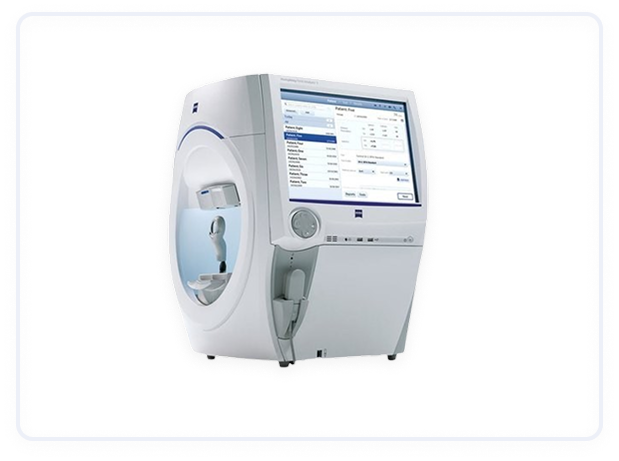
Visual Field Analyzer
A Visual Field Analyzer (VFA) is a diagnostic tool used to assess the visual field of a patient, which refers to the entire area that can be seen when the eyes are fixed in one position. It is used primarily to detect peripheral vision loss and assess central vision, and is essential in diagnosing and monitoring diseases that affect the optic nerve, retina, and parts of the brain responsible for vision processing.
Types of Visual Field Analyzers
Humphrey Visual Field Analyzer:
One of the most widely used instruments, the Humphrey Visual Field Analyzer (by Zeiss), provides highly accurate and reproducible results, particularly for detecting glaucoma. It uses static perimetry and offers various test patterns for comprehensive analysis.
Octopus Visual Field Analyzer:
The Octopus is another commonly used visual field analyzer that provides both static and kinetic perimetry. It is especially well-regarded for its flexibility, allowing customized test patterns for specific patient needs.
Matrix Perimeter:
This is a compact, portable device that offers visual field testing with Frequency Doubling Technology (FDT). It is particularly useful for screening for early glaucoma or neurological visual defects.
Goldmann Perimeter:
This older, manual device is still in use today, particularly in specialized centers for kinetic perimetry testing. It allows for both kinetic and static visual field assessments and is often used in research.
Limitations and Considerations
Patient Cooperation:
The accuracy of the test relies on the patient's ability to respond accurately. In patients with poor concentration or those unable to follow instructions (e.g., young children or people with cognitive impairments), the results may be less reliable.
Test Duration:
Some visual field tests, particularly static perimetry, can take a long time to complete (often up to 20-30 minutes), which may be uncomfortable for some patients.
Learning Curve:
Proper interpretation of the visual field map requires expertise. Clinicians need to understand how to interpret the data and distinguish between normal and abnormal results, as well as identify disease-specific patterns.
False Positives/Negatives:
In certain cases, the results may be false positives (indicating problems where there aren't any) or false negatives (failing to detect an existing problem). Factors like patient fatigue, improper fixation, or technical errors can affect results.
Limitations and Considerations
Patient Cooperation:
The accuracy of the test relies on the patient's ability to respond accurately. In patients with poor concentration or those unable to follow instructions (e.g., young children or people with cognitive impairments), the results may be less reliable.
Test Duration:
Some visual field tests, particularly static perimetry, can take a long time to complete (often up to 20-30 minutes), which may be uncomfortable for some patients.
Learning Curve:
Proper interpretation of the visual field map requires expertise. Clinicians need to understand how to interpret the data and distinguish between normal and abnormal results, as well as identify disease-specific patterns.
False Positives/Negatives:
In certain cases, the results may be false positives (indicating problems where there aren't any) or false negatives (failing to detect an existing problem). Factors like patient fatigue, improper fixation, or technical errors can affect results.
Various industries
Request More Information
Contact Us to learn more about our offerings or Request a Quote to get started today!
Contact Us

