
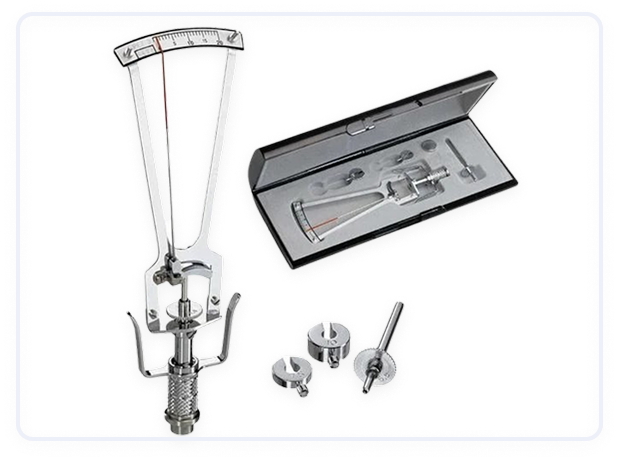
Tonometer
A tonometer is a medical instrument used to measure intraocular pressure (IOP), which is the pressure inside the eye. Measuring IOP is a key diagnostic tool in ophthalmology, especially for detecting glaucoma and monitoring the condition of the eye in various other conditions, such as ocular hypertension or post-surgical eye care.
Types of Tonometers
Goldmann Applanation Tonometer (GAT):
Goldmann applanation tonometer is the gold standard in IOP measurement. It works based on the principle that the amount of force required to flatten a small area of the cornea is proportional to the IOP.
Procedure: The patient must sit at a slit lamp, and the tonometer probe touches the cornea. The device measures the amount of force needed to flatten a small area of the cornea, which is then translated into IOP readings.
Non-Contact Tonometer (NCT):
The non-contact tonometer uses a puff of air to measure the IOP by observing how the eye responds to the air blast.
Procedure: The patient sits with their chin on a chin rest and looks straight ahead. A puff of air is directed toward the cornea, and the tonometer measures how much the cornea flattens in response to the air, which correlates to IOP.
Applanation Tonometer:
Similar to the Goldmann tonometer but used as a handheld device. It also works on the principle of flattening the cornea.
Tono-Pen:
The Tono-Pen is a handheld, portable version of an applanation tonometer. It is commonly used for bedside testing or for patients who are unable to sit at a slit lamp (e.g., bedridden patients).
Procedure: It requires minimal contact with the cornea. The probe touches the cornea, and the device measures IOP by making several quick measurements at different points on the eye.
Rebound Tonometer (iCare Tonometer):
The iCare tonometer uses a tiny probe that gently makes contact with the cornea. The rebound principle involves measuring the time it takes for the probe to bounce off the cornea.
Procedure: The probe briefly contacts the cornea and bounces off. The device calculates IOP based on the time it takes for the probe to return to the device.
Dynamic Contour Tonometer (DCT):
The dynamic contour tonometer measures the IOP by using a sensor that aligns with the curvature of the cornea, offering an accurate reading regardless of corneal thickness.
Procedure: The device’s sensor is placed gently on the cornea, and the IOP is measured based on the contour of the eye’s surface.
Ocular Response Analyzer (ORA):
The ORA measures IOP by using a pneumotonometry method, analyzing how the cornea deforms under a puff of air.
Various industries
Request More Information
Contact Us to learn more about our offerings or Request a Quote to get started today!
Contact Us

