
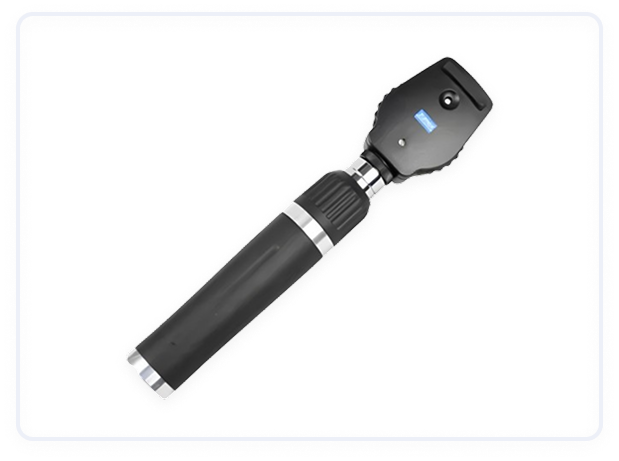
Ophthalmoscope
An ophthalmoscope is a medical instrument used by healthcare professionals, particularly ophthalmologists and optometrists, to examine the interior structures of the eye, particularly the retina, optic disc, macula, and blood vessels. This tool allows the doctor to visualize the fundus of the eye, which is essential for diagnosing various eye conditions and diseases, as well as assessing the overall health of the eye.
Key Components of an Ophthalmoscope
Light Source : Provides illumination for viewing the inside of the eye. Modern ophthalmoscopes use LED lights for a bright and consistent light source.
Adjustable Lenses : Ophthalmoscopes come with adjustable lenses (diopters) that allow the examiner to focus the image, correcting for their own vision or any patient refractive errors. These lenses range from -25 to +40 diopters.
Filters : Many ophthalmoscopes come equipped with different filters that enhance the clarity of certain structures. For example, a red-free filter can help in visualizing blood vessels more clearly, and a blue light filter can assist in detecting fluorescein dye during diagnostic tests.
Magnification : Most ophthalmoscopes have the ability to adjust magnification, which helps to focus on specific structures, such as the optic disc or macula.
Types of Ophthalmoscopes
Direct Ophthalmoscope:
The direct ophthalmoscope is the most commonly used type and is a handheld device that provides a bright light source and small lens. The examiner holds the ophthalmoscope close to the patient’s eye and views the fundus directly.
Indirect Ophthalmoscope:
The indirect ophthalmoscope is a more sophisticated tool that consists of a headset worn by the examiner, with a light source and a lens positioned in front of the patient's eye.
The light from the headset shines into the patient’s eye, and the examiner views the fundus through a hand-held lens.
Digital or Non-Mydriatic Fundus Camera:
This is a more advanced type of ophthalmoscope used in clinics and hospitals. It provides high-quality digital images of the retina, which can be stored for further analysis or comparison over time.
Types of Ophthalmoscopes
Direct Ophthalmoscope:
The direct ophthalmoscope is the most commonly used type and is a handheld device that provides a bright light source and small lens. The examiner holds the ophthalmoscope close to the patient’s eye and views the fundus directly.
Indirect Ophthalmoscope:
The indirect ophthalmoscope is a more sophisticated tool that consists of a headset worn by the examiner, with a light source and a lens positioned in front of the patient's eye.
The light from the headset shines into the patient’s eye, and the examiner views the fundus through a hand-held lens.
Digital or Non-Mydriatic Fundus Camera:
This is a more advanced type of ophthalmoscope used in clinics and hospitals. It provides high-quality digital images of the retina, which can be stored for further analysis or comparison over time.
Various industries
Request More Information
Contact Us to learn more about our offerings or Request a Quote to get started today!
Contact Us

