
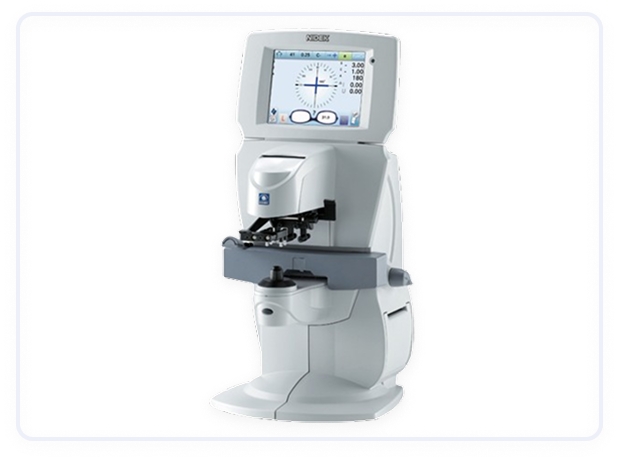
Auto Lensmeter
An auto lensmeter (also known as an automatic lensmeter, lensometer, or focimeter) is a crucial optical instrument used to measure the prescription of eyeglass lenses. It helps determine the focal power of lenses (in diopters), the axis of astigmatism, and the prism in the lenses. The auto lensmeter automates the process, making it faster and more efficient than traditional, manual lensmeters. It is widely used in optometry clinics, optical labs, and optical retail stores.
Key Features of an Auto Lensmeter
Automatic Measurement:
The auto lensmeter automatically measures the refractive properties of lenses. It is equipped with sensors that detect the light reflection from the lens and determine key parameters such as the sphere power, cylinder power, axis, and prism. This reduces the need for manual adjustments and makes the process quicker and more accurate.
Digital Display:
Modern auto lensmeters feature a digital display that shows the measurements directly on the screen. These readings are typically displayed in diopters (D) for the power and degrees (°) for the axis.
Measuring for Spherical and Cylindrical Lenses:
Spherical lenses: These are the most common type of lenses used to correct nearsightedness (myopia) or farsightedness (hyperopia).
Cylindrical lenses: These are used to correct astigmatism, a refractive error caused by an irregular shape of the cornea or lens.
Prism Measurement:
The auto lensmeter can also measure the prism (a lens property that helps correct eye misalignment) and prism base to detect any prism correction needed for the lens.
Pupil Distance (PD) Measurement:
Some auto lensmeters are capable of measuring pupillary distance (PD), which is the distance between the centers of the pupils. This is a critical measurement to ensure that lenses are positioned correctly for the patient’s eye alignment.
Eye Piece or Sensor:
The eye piece or sensor is the part where the operator places the lens to be tested. This part detects the reflection of light passing through the lens, enabling the machine to measure the lens's refractive properties.
User-Friendly Interface:
Modern models come with touchscreen interfaces or buttons to allow easy access to different measurement modes. Users can switch between measuring single vision lenses, bifocal lenses, and progressive lenses without difficulty.
Lens Type Detection:
Some advanced auto lensmeters can automatically detect whether a lens is a single vision, bifocal, or progressive lens. This feature simplifies the lens measurement process and ensures that the correct parameters are measured for each type of lens.
Various industries
Request More Information
Contact Us to learn more about our offerings or Request a Quote to get started today!
Contact Us

