
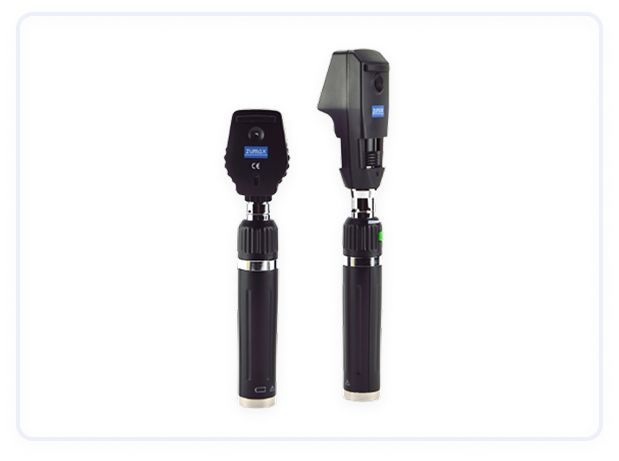
Retinoscope
A retinoscope is an essential diagnostic instrument used by optometrists and ophthalmologists to examine the reflex of the retina and assess a patient's refractive error (such as myopia, hyperopia, and astigmatism). It works by shining a light into the eye and observing the reflex (reflection) from the retina to determine how the light is focused. This helps to measure how well the eye is focusing light and, subsequently, to determine the proper prescription for corrective lenses like glasses or contact lenses.
Key Features of a Retinoscope
Light Source:
A retinoscope has an integrated light source that is directed into the patient's eye. The light is typically bright and focused, and it is used to stimulate the retina.
The light is reflected from the retina, and by observing the reflex, the examiner can gather information about the eye’s refractive status.
Reflex Observation:
The device allows the clinician to observe the retinal reflex (light reflection) to assess how the eye focuses the light. The movement of the reflex helps determine whether the patient has a nearsighted (myopia), farsighted (hyperopia), or astigmatism condition.
The reflex movement can be "with" or "against" the light depending on the refractive error of the eye.
Manual or Automated Models:
There are both manual and automated retinoscopes. Manual models require the examiner to move the instrument to different positions around the patient's eye, while automated versions are equipped with technology to help provide more accurate and quick results.
Automated devices may include digital retinoscopes that provide an instant refractive error measurement and help the clinician adjust parameters more easily.
Adjustable Mirror and Lens System:
The mirror in a retinoscope can be adjusted to project light at different angles and distances, ensuring that the light reaches the retina in the correct manner.
Portable and Compact Design:
Retinoscopes are designed to be compact, portable, and lightweight, making them easy to carry for optometrists and ophthalmologists in both clinic and mobile settings.
Illumination Control:
Some models feature variable illumination settings, allowing the clinician to control the intensity of light based on the patient's needs (for example, adjusting for pediatric patients who might be sensitive to brighter lights).
Large Viewfinder:
Retinoscopes typically have a large viewfinder or lens system that enables easy observation of the reflex from the retina.
It is designed to offer clear and sharp images, helping the clinician to make more accurate measurements.
Various industries
Request More Information
Contact Us to learn more about our offerings or Request a Quote to get started today!
Contact Us

