
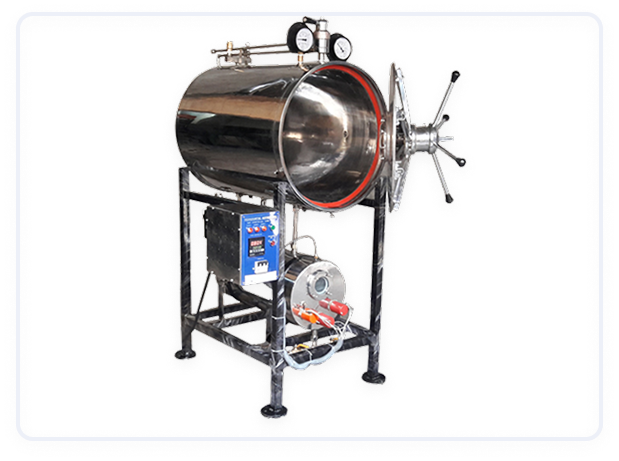
Horizontal Autoclave
A Horizontal Autoclave is a type of sterilization equipment used in healthcare settings, particularly in the Central Sterile Supply Department (CSSD). It plays a crucial role in ensuring that medical instruments, surgical tools, and other equipment are thoroughly disinfected and free of pathogens before being reused. Horizontal autoclaves are one of the most commonly used types of autoclaves in hospitals and medical facilities due to their ability to sterilize large quantities of equipment efficiently.
Key Features of Horizontal Autoclaves
Horizontal Loading and Unloading:
Unlike vertical autoclaves where items are loaded from the top, horizontal autoclaves have a door on the side that opens horizontally, making it easier to load and unload larger items or bulkier equipment. This configuration allows for more efficient handling of medical instruments, especially in high-volume environments like CSSDs.
Sterilization Process:
Steam Sterilization: Horizontal autoclaves operate using saturated steam under high pressure to sterilize medical instruments and equipment. The steam penetrates the items, raising the temperature to around 121°C to 134°C for a set period, typically 15 to 30 minutes, depending on the load.
Advanced Control Systems:
Modern horizontal autoclaves are equipped with microprocessor-controlled systems that regulate the temperature, pressure, and time cycles automatically. These systems ensure consistency and reproducibility, reducing the chances of human error and improving reliability.
Many autoclaves also feature integrated drying cycles, ensuring that sterilized items are not only disinfected but also dry and ready for use after the sterilization process.
Capacity and Efficiency:
Horizontal autoclaves are available in various sizes and capacities, with some models designed for high-throughput environments capable of handling large volumes of instruments, while others are more compact for smaller medical practices.
The larger chamber of horizontal autoclaves allows for the sterilization of bulkier instruments or multiple instrument sets at once, making them ideal for busy CSSDs where high volumes of instruments need to be processed quickly.
Safety Features:
Automatic Door Locking: These autoclaves are equipped with automatic door locking mechanisms that prevent the door from opening during the sterilization cycle, ensuring the safety of operators.
Overpressure Protection: Horizontal autoclaves include built-in safety mechanisms to release excess pressure and avoid dangerous situations like explosions.
Types of Sterilization Cycles:
Gravity Displacement: In this cycle, steam enters the chamber and displaces air out, which is ideal for sterilizing solid instruments.
Prevacuum: This cycle uses a vacuum pump to remove air from the chamber before steam is introduced, ensuring a more thorough sterilization of hollow items or items with complex geometry like surgical instruments.
Material Compatibility:
Horizontal autoclaves are designed to safely sterilize a wide variety of materials used in medical settings, including metal instruments, plastic goods, glassware, and textiles like surgical drapes, gowns, and linen. Proper packaging of the materials ensures that they are effectively sterilized.
Various industries
Request More Information
Contact Us to learn more about our offerings or Request a Quote to get started today!
Contact Us

