
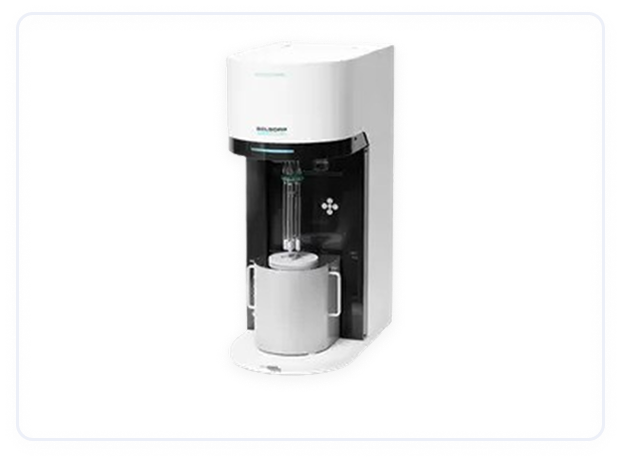
Surface Area and Pore Size Distribution Analyzer
A Surface Area and Pore Size Distribution Analyzer is an analytical instrument used to determine the surface area, pore volume, and pore size distribution of materials, particularly fine powders, porous materials, catalysts, and adsorbents. These properties are crucial in various industries, including pharmaceuticals, materials science, environmental science, and energy production, where surface interactions and porosity significantly influence the material’s behavior and performance.
Key Features of Surface Area and Pore Size Distribution Analyzer :
Principle of Operation :
These analyzers typically use the gas adsorption technique, most commonly nitrogen adsorption at liquid nitrogen temperature (77 K) as the standard method for measuring surface area and porosity.
Brunauer-Emmett-Teller (BET) Method : The primary technique used for surface area determination. It involves adsorbing a gas (commonly nitrogen) onto the surface of a material at a specific temperature, and then measuring the amount of gas that adsorbs. The BET equation is used to calculate the surface area based on the amount of gas adsorbed at different relative pressures.
Pore Size Distribution : This is determined by measuring the amount of gas adsorbed as a function of pressure, and using models like Barrett-Joyner-Halenda (BJH) or Horvath-Kawazoe for pore size analysis.
Parameters Measured :
Surface Area :
Measured in square meters per gram (m²/g), surface area is an essential parameter that indicates how much surface is available for chemical reactions, adsorption, or other surface interactions.
It’s critical for catalysts, adsorbents, and pharmaceutical formulations where surface reactivity plays a significant role.
Pore Volume :
Pore volume refers to the total volume of pores in a material, typically measured in cubic centimeters per gram (cm³/g). It gives insight into the material’s capacity to hold gases or liquids.
Pore Size Distribution :
This refers to the distribution of pore sizes within a material, helping to determine whether the material is microporous, mesoporous, or macroporous. Understanding the pore size distribution is vital for applications like adsorption, catalysis, filtration, and energy storage.
Pore Shape and Structure :
Analysis can also provide information on the geometry and connectivity of pores within the material.
Types of Materials Analyzed :
Porous Materials : Used for materials like zeolites, activated carbon, silica, and metal-organic frameworks (MOFs).
Catalysts : Catalytic materials, where surface area and pore size distribution are directly related to catalytic activity.
Pharmaceuticals : Used for excipients, active pharmaceutical ingredients (APIs), and formulations where the surface area affects dissolution rates.
Environmental Samples : For pollutants or soil samples where porosity and surface area are essential for understanding adsorption behavior.
Nanomaterials : Nanoparticles, nanotubes, and nanocomposites, where surface interactions dominate material properties.
Techniques for Measurement :
Nitrogen Adsorption (most common):
The sample is first degassed to remove any adsorbed moisture or contaminants.
Nitrogen gas is then adsorbed onto the material surface at low temperatures, and the amount of nitrogen adsorbed is measured at various relative pressures.
The BET method is used to calculate the surface area from the adsorption data.
Carbon Dioxide or Argon Adsorption : In some cases, carbon dioxide or argon is used instead of nitrogen, depending on the properties of the material being tested.
Mercury Intrusion Porosimetry : A method used for measuring larger pores and total porosity. It forces mercury into the pores under increasing pressure, and the volume of mercury intrusion is measured to determine pore volume and distribution.
Various industries
Request More Information
Contact Us to learn more about our offerings or Request a Quote to get started today!
Contact Us

