
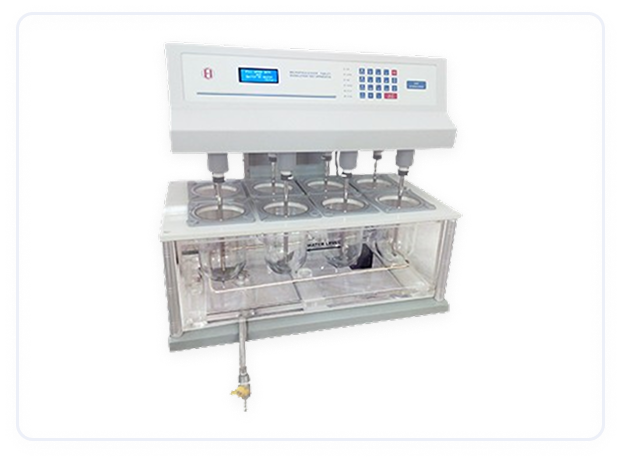
Dissolution Test Apparatus
A Dissolution Test Apparatus is a laboratory instrument used primarily in the pharmaceutical industry to measure the rate and extent to which a drug (usually in tablet or capsule form) dissolves in a particular solvent, typically under controlled conditions. This test is crucial for ensuring the proper bioavailability of pharmaceutical products, meaning that the active ingredients are released into the bloodstream at the correct rate and to the correct extent.
Key Features and Functions of a Dissolution Test Apparatus :
Purpose and Function :
Drug Release Measurement : The dissolution test measures how quickly and completely a drug releases its active ingredients when exposed to a particular solvent. This simulates how a drug would dissolve in the gastrointestinal tract (GI tract) after administration.
Quality Control : The test ensures that drugs meet regulatory requirements for their release profiles, helping to determine whether a product will work as intended once ingested by the patient.
Formulation Development : It helps pharmaceutical companies develop and optimize formulations to ensure effective drug delivery.
Bioavailability Testing : The dissolution test is a part of bioequivalence and bioavailability studies, particularly for generic drugs, to ensure that the drug dissolves at the same rate as the reference product.
How a Dissolution Test Apparatus Works :
A typical dissolution test apparatus consists of several key components :
Dissolution Vessel : The test substance (usually a tablet or capsule) is placed in a vessel filled with a dissolution medium (a solvent or simulated gastric fluid).
Stirring Mechanism : The vessel is equipped with a stirring mechanism to simulate the agitation in the gastrointestinal tract. The stirrer helps to maintain uniform conditions within the vessel by moving the medium around the sample.
Temperature Control : The temperature of the dissolution medium is maintained at a constant level to replicate physiological conditions, often at 37°C, which is the average human body temperature.
Sampling System : The dissolution apparatus includes a system for periodically sampling the dissolution medium to measure the concentration of the active ingredient as it dissolves.
Sampling Port/Probe : A port or probe is used to withdraw small samples of the dissolution medium for analysis at predetermined intervals during the test.
Detector/Analyzer : After sampling, the active ingredients in the dissolution medium are analyzed, usually through techniques such as UV-Vis spectrophotometry or HPLC (High-Performance Liquid Chromatography), to measure the amount of drug dissolved over time.
Types of Dissolution Test Apparatus :
USP Type I (Basket Method) :
Design : A cylindrical basket (usually made of wire mesh) holds the dosage form (tablet or capsule) and is lowered into the dissolution medium. The basket is then rotated to simulate the conditions of the stomach.
Applications : This method is commonly used for capsules or tablets that are designed to dissolve or disintegrate in the stomach.
Standard : It is one of the most commonly used methods and is outlined in the United States Pharmacopeia (USP).
USP Type II (Paddle Method) :
Design : In this method, a flat, cylindrical paddle is positioned just above the dissolution vessel and rotates at a set speed. The tablet or capsule is placed at the bottom of the vessel, and the paddle stirs the dissolution medium.
Applications : This method is commonly used for tablets that do not require the basket method, especially for those formulated to dissolve in the stomach.
Standard : It is widely used in the pharmaceutical industry for testing a broad range of oral dosage forms.
USP Type III (Reciprocating Cylinder Method) :
Design : This apparatus involves a reciprocating cylinder that moves vertically in and out of the dissolution medium, allowing for a more dynamic simulation of the gastrointestinal tract.
Applications : This method is used for testing dosage forms like hydrogel formulations or controlled-release formulations.
USP Type IV (Flow-Through Cell Method) :
Design : This method uses a flow-through cell where the dissolution medium flows continuously over the sample. The sample is held within a small container, and the dissolution medium is pumped through it at a constant flow rate.
Applications : It is suitable for testing implants, extended-release formulations, and other formulations that require a dynamic testing environment.
Various industries
Request More Information
Contact Us to learn more about our offerings or Request a Quote to get started today!
Contact Us

